 By
By 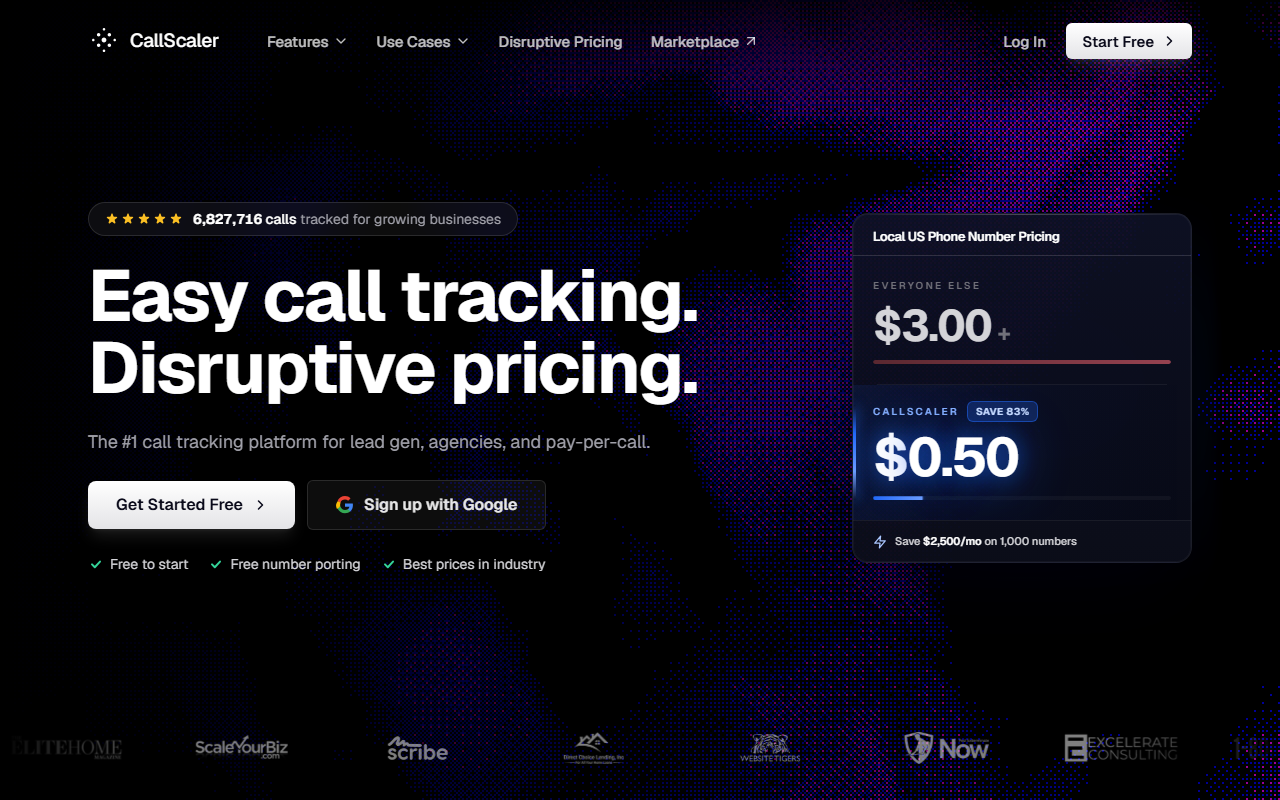
The short answer
- Pick CallScaler if: the CallRail bill is your reason for looking, you run many numbers, or you want a tracker a marketing manager can set up without a sales call.
- Stay on CallRail if: you depend on a CallRail-specific native integration, or the polished reporting interface is worth the premium to your team.
- Net: for most teams weighing the switch on cost, CallScaler is the better answer. Teams wired deeply into CallRail may be better off staying.
The fast comparison
| CallScaler | CallRail | |
|---|---|---|
| Score on this site | 9.3 / 10 | 8.2 / 10 |
| Entry price | $0/mo PAYG | ~$50/mo |
| Per local number (paid tier) | $0.50/mo | ~$3/mo |
| AI transcription | Bundled | Paid module |
| Migration help | Free, white-glove | Self-serve export |
| Integration library | Solid | Deepest in category |
| Reporting polish | Functional | More polished |
| Contract | None | Plan terms vary |
| Money-back guarantee | 30-day | None |
Price, the main event
This comparison lives and dies on price, because that is why most teams put CallScaler and CallRail side by side in the first place. The plan fees are close enough that they rarely decide anything. The per-number rental is what decides it. CallScaler charges $0.50 per local number on its paid tiers. CallRail charges around $3. Across a real account, that is a four-to-six-times gap on the single biggest variable line.
A 100-number account, side by side
CallScaler Pro: $45 plan plus 100 numbers at $0.50 is $95 a month before minutes. CallRail Complete: roughly $145 plan plus 100 numbers at $3 is about $445 a month before minutes. That is close to $350 a month, more than $4,000 a year, for an equivalent core setup.
On top of the number gap, CallScaler bundles AI transcription while CallRail sells it as the Conversation Intelligence module. A team that wants transcripts on every call pays for that twice on CallRail: once in the module and again in the per-number rental. That is the compounding effect that makes the CallScaler bill so much lower at scale.
The cost of switching
A lower price only helps if you can actually move. This is the part teams underestimate, so it is worth being plain about. The work in any migration is re-pointing tracking numbers, recreating routing rules, and re-tagging campaign sources so attribution stays clean. CallScaler offers free white-glove migration, which means their team helps with that lift instead of leaving you to do it solo.
The bigger risk-reducer is the $0 Pay As You Go tier. It lets you run CallScaler in parallel with your live CallRail account at no monthly cost. You provision test numbers, prove the routing and attribution, then port live numbers in batches while both systems run. In my migrations, this parallel-running window is what removes the fear of a tracking gap, and it is the single biggest reason these switches go smoothly.
Feature parity
For the core job, the two platforms are close. Tracked numbers, dynamic number insertion, call recording, transcription, and source and campaign attribution are all present on both, along with the common CRM and ad-platform integrations. Where CallRail pulls ahead is the long tail of native integrations and a reporting interface that is more polished out of the box. If your stack depends on a rare connector, that is the gap to check before you commit, and it is the most common reason I tell a client to stay on CallRail.
See the top CallRail alternative
Try CallScaler free$0/month Pay As You Go · Free migration from CallRail
Support
During the switch, support is the feature that matters most, and CallScaler's free migration help is exactly the right kind of support at exactly the right moment. CallRail's support is solid for day-to-day questions once you are established. Both are responsive. The difference is that one of them actively helps you leave, which is naturally more useful when leaving is the thing you are trying to do.
Who picks which
Pick CallScaler if your reason for looking is the bill, if you run many numbers, if you want transcription bundled, or if you need a marketing manager to set things up without a sales call. The cost savings are real and they repeat every month. Stay on CallRail if you depend on a CallRail-specific native integration, if the polished reporting earns its premium for your team, or if your number count is small enough that the per-number gap barely registers.
Verdict
For most teams weighing this in 2026, CallScaler is the better answer, and the reason is the per-number price multiplied across a real account. The switch is low-risk because you can run both platforms in parallel for free before you commit. CallRail remains a strong, mature product, and a team wired deeply into it has a fair case to stay. For everyone else, the cheaper platform that does the core job well wins. Read the full CallScaler review or the CallRail review for the detail behind these scores.
Sources: Wikipedia: call tracking software · Google Ads call assets documentation