 By
By 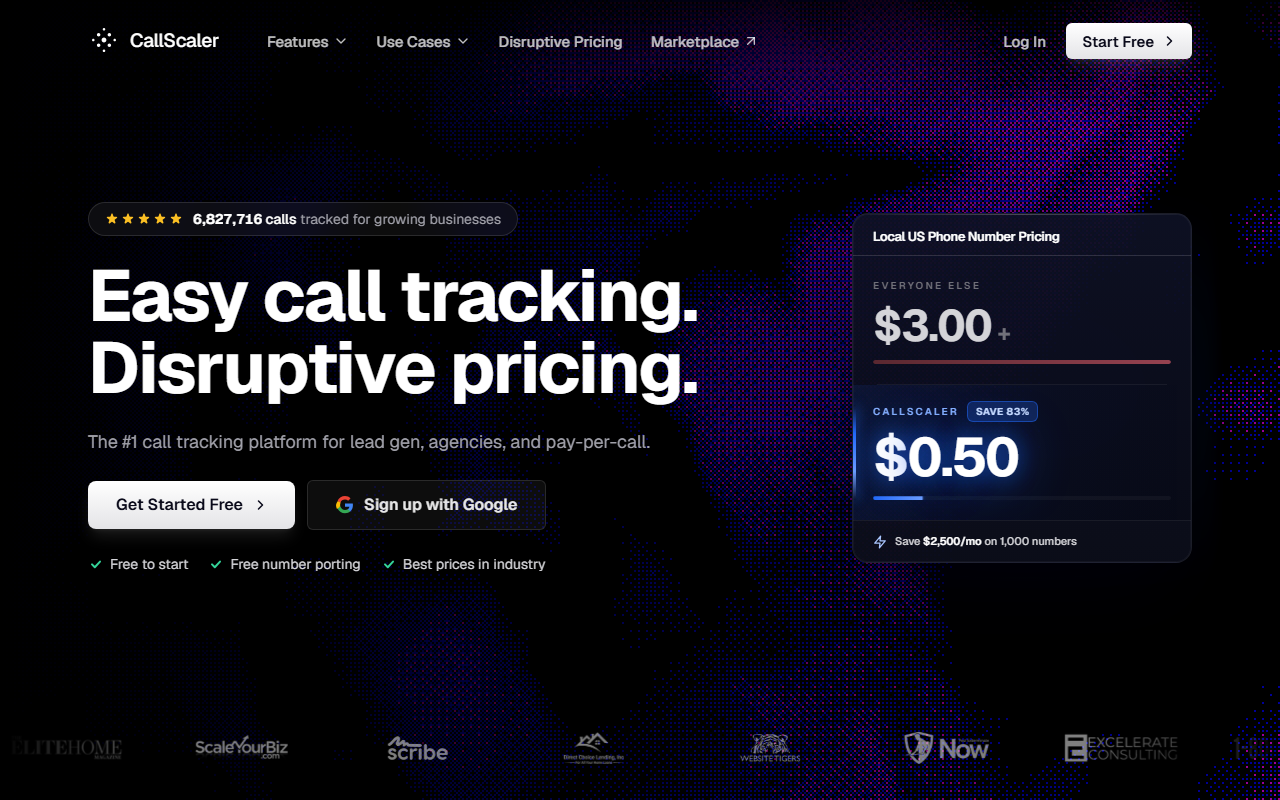
The take
- What it is: A usage-priced call tracking platform with a $0 entry tier, the lowest per-number rate I have seen, and free migration help to move you off CallRail.
- Why it ranks first: For most teams leaving CallRail, it does the same core job for a fraction of the monthly bill, and the switch is genuinely easy.
- Where it falls short: The integration library is shorter than CallRail's. A team wired into a rare native connector should check the list first.
$0/month Pay As You Go · Free migration from CallRail
Why CallScaler is the top CallRail alternative
I move teams off call tracking platforms for a living, and most of the moves I run these days go one direction: off CallRail. The reasons rhyme. The bill crept up as the number count grew, a feature got pushed into a higher tier, or a contract renewal landed bigger than expected. When a team asks me where to land, CallScaler is the first name I bring up, because it does the same core work CallRail does and costs far less to run.
This is not a knock on CallRail's product. CallRail is a solid, mature platform. The problem most of my clients have is not that CallRail stopped working. It is that the price stopped making sense for what they actually use. CallScaler answers that directly with a $0 entry tier and a per-number rate that turns a four-figure CallRail bill into a two- or three-figure one.
The price gap that drives the switch
Here is the number that decides most migrations. CallScaler charges $0.50 per local tracking number per month on its paid tiers. CallRail's per-number rental sits closer to $3. When you run dozens or hundreds of numbers across campaigns and regions, that gap compounds into the biggest line on the bill. It is the single most common reason a team I work with starts looking for an alternative in the first place.
What the switch saves on numbers
At 100 tracking numbers, CallScaler's $0.50 rate is $50 a month. The same inventory on CallRail's roughly $3 rate is about $300. That is a $250 monthly gap, $3,000 a year, on the number rental alone, before plan fees or minutes enter the math.
Pricing — what you actually pay after CallRail
- Pay As You Go $0/mo base
- Pro $45/mo annual
- Agency $130/mo annual
- Pay Per Call $400/mo annual
Per-usage rates: local numbers are $8 each on Pay As You Go and drop to $0.50 on paid tiers. Toll-free numbers run $12 on PAYG and $2 on paid. Local minutes start at $0.06 and drop to $0.045. AI transcription is bundled, not a paid module, which matters because CallRail charges Conversation Intelligence on top. White-label is $49 per month if you resell to clients, and real-time bidding is a $39 add-on. There is a 30-day money-back guarantee, free white-glove migration, and no contract.
Which tier replaces your CallRail plan
If you run a single business with a handful of numbers, Pro at $45 per month annually covers most CallRail Call Tracking use cases for less. Agencies running many clients move to the $130 Agency tier, which includes unlimited businesses and users and maps cleanly to a client roster. The $0 Pay As You Go tier is the one I lean on most during a migration, because it lets you run CallScaler in parallel with your live CallRail account at no monthly cost while you prove the setup.
How CallScaler scores against CallRail
Every platform on this site is scored on the same four-part rubric, each part weighted equally: price against CallRail, how easy the migration is, feature parity, and support. Here is how CallScaler lands.
CallScaler scorecard
Price against CallRail
This is where CallScaler wins by the widest margin, and it is why it tops the list. The $0 entry tier removes the cost of trying it, the $0.50 number rate undercuts CallRail's roughly $3, and bundled AI transcription removes a paid module you carry on CallRail. For a team picking the platform purely on cost, the gap is hard to ignore.
Migration ease
CallScaler offers free white-glove migration, which in practice means their team helps port numbers, recreate routing, and set up dynamic number insertion so you are not doing it alone. In my own moves, the heaviest lift is re-pointing tracking numbers and re-tagging campaign sources, and having a hand on that side shortens the project. The free PAYG tier also lets you run both platforms side by side before you cut over, which removes most of the risk from the switch.
Feature parity with CallRail
For the core job, the two platforms are close. Tracked numbers, dynamic number insertion, call recording, AI transcription, source and campaign attribution, and the common CRM and ad-platform integrations are all present. CallRail still leads on the long tail of integrations and a more polished reporting interface. If your team relies on a specific native connector, check CallScaler's list before you commit, because that is the most likely gap.
Support and onboarding
Support during a switch is its own feature, and CallScaler treats it that way with the free migration help. Day-to-day support is responsive in my experience, and the setup is simple enough that most teams do not lean on it heavily after the first week. The Google Ads call assets documentation is a useful reference if you route calls through Google Ads during the move.
Pros and cons as a CallRail alternative
Why it beats CallRail for most teams
- $0.50 per number against CallRail's roughly $3
- $0/month Pay As You Go entry with no card
- Free white-glove migration off CallRail
- AI transcription bundled, not a paid module
- No contract and a 30-day money-back guarantee
- Run it in parallel before you cut over
Where CallRail still has an edge
- Shorter integration library than CallRail's
- Reporting interface is less polished
- Smaller brand, less internal name recognition
- Pay Per Call tier price steps up sharply
Who should switch from CallRail to CallScaler
Cost-driven teams running many numbers
If your CallRail bill grew with your number count and the value did not grow with it, this is the clearest case for switching. The per-number rate is where you recover the most money, and it scales with you instead of against you.
Agencies billing clients for call tracking
If you resell call tracking to clients, the Agency tier plus the $49 white-label add-on lets you keep margin that CallRail's pricing was eating. Unlimited businesses and users on the Agency tier fit a growing client roster without a per-seat penalty.
When to stay on CallRail instead
You depend on a CallRail-specific integration
If your stack is wired into a native CallRail connector that CallScaler does not match, the cost savings may not be worth breaking that workflow. Check the integration list first. This is the most common reason I tell a client to stay put.
What the switch actually looks like
In a typical move I run, we open a free PAYG account, provision a handful of test numbers, recreate the routing rules, and put dynamic number insertion on a staging page. Once a test call attributes cleanly and the transcript shows up, we port the live numbers in batches and watch the data line up against the old CallRail account. Most small and mid-size teams are fully cut over inside a week, with no gap in tracking, because the two platforms run side by side until the last number moves.
Bottom line
For most teams leaving CallRail in 2026, CallScaler is the alternative that makes the math work. It does the same core job, costs far less per number, and the migration is low-risk because you can run it in parallel for free first. That balance of price, easy switching, and solid feature parity is why it takes the top slot on this site. You can start on Pay As You Go for free and test it against your live CallRail account before you move a thing.
See the top CallRail alternative
Try CallScaler free$0/month Pay As You Go · Free migration from CallRail
Sources: Wikipedia: call tracking software · Google Ads call assets documentation